


eu-leaders high tech course
-
1. e-leadership styles & e-management strategies5 Topics|1 Quiz
-
2. e-ethics2 Topics|1 Quiz
-
3. e-social skills and e-team building skills4 Topics|1 Quiz
-
4. Information and data literacy6 Topics|1 Quiz
-
What is Information and data literacy?
-
How to critically evaluate the quality and relevance of information they find, as well as how to distinguish between trustworthy and unreliable source
-
Skills to manage data effectively, including how to collect, organize, analyse, and interpret data to make informed decisions
-
How to protect sensitive information, including the importance of data privacy, cybersecurity, and compliance with relevant laws and regulations
-
How to communicate the results of their research and analysis effectively to stakeholders in a clear and concise manner
-
IDL skills to real-world situations and in a practical setting.
-
What is Information and data literacy?
-
5. Information security6 Topics|1 Quiz
-
6. e-technology Skills – Innovative digital tools5 Topics|1 Quiz
-
7. Evaluation and effective follow up techniques5 Topics|1 Quiz
Case studies

Deloitte (Effective follow up techniques)
How Deloitte enable remote work arrangements (Deloitte Development LLC., 2020 & Deloitte Ireland LLP., 2023):
Remote worker compliance
The Deloitte Remote Workers Identifier uses a simple survey to identify employee whereabouts to enable an up-to-date analysis to be performed, assessing mandatory compliance obligations. The data can be presented in a user friendly dashboard and enables a triage process to be implemented to prioritize actions.
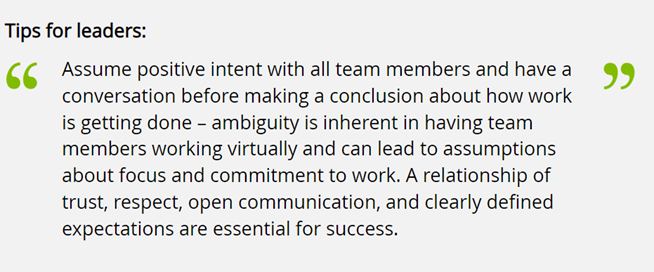
Set expectations
- Set of rules of engagement: how often to communicate, give updates and when employees should be available for teamwork.
- Track progress in real-time. Use software to keep employees updated on tasks.
Refresh roles and responsibilities
- E-leaders review, update and ensure clarity of roles and objectives within the team when working remotely.
- E-leaders are accessible to their team and establish open channels of communication for questions or concerns.
Give feedback
- Regular and timely feedback helps keep teams informed and on track with deliverables.
Stay connected
- Use collaboration tools (Skype, Zoom, etc.) for regular interactions in the absence of physical meetings. Frequent virtual interactions help maintain communication and morale. Employees appreciate checking in on a personal level.
Current trends in remote working – A study from KPMG International
KPMG International has conducted a study and asked more than 530 companies from 46 jurisdictions about their current remote working considerations and decisions in the context of a global webcast: “Work from Anywhere: Insights from the research and government perspective”. Participants included board members, managers and experts from the fields of global mobility, human resources (HR), tax and labor law from a cross-section of industries (KPMG International, 2022).
Results:
1. The rise of remote working policies
The 52% of companies surveyed have already introduced a remote working policy and the 37% are currently considering one. The numbers reveal that the vast majority are following a long-term strategy for remote working. However, strategies vary depending on each organization — their business model, their long-term strategic goals and their corporate culture. There is currently no one-size-fits-all approach.
2. The reasons why
Based on the results of the study, Employee requests and COVID-19 restrictions are the key reasons for remote working.
What do these results show?
Focusing on employer branding and the employee value proposition will become increasingly important for businesses. To succeed in competitive markets and achieve future growth targets, companies will need to meet the demand for more workplace flexibility. If managed well, implementing remote working will lead to further positive changes such as increasing productivity rates, cost savings potential, and support in achieving environmental, social and governance (ESG) objectives, as well as diversity and inclusion goals.
3. The responsible functions
HR, tax and global mobility are responsible for cross-border remote working arrangements, but cannot do it without the collaboration from all the relevant stakeholders. Due to the complexity involved, no one function can handle cross-border remote working projects on its own and independently from other functions and stakeholders. Remote working requires a whole network of experts and workstreams to model the case for change, agree to the design principles, design a policy, as well as to implement the processes.
4. The challenges
The biggest challenge for the majority of participants (38%) is Tax and legal compliance. There is a variety of tax and legal regulations that need to be considered within country borders. For example, employer obligations concerning health and safety, data protection and IT security, participation rights, income and corporate tax regulations. Outside the national border, compliance becomes even more complex as further local and international regulations come into account. The lack of legal standards and the uncertainty about the future development of tax and legal landscapes, represent a significant barrier to address cross-border remote working. If remote work is implemented, companies generally define employee and work-related guardrails to reduce compliance risks. These guardrails then also need to be reflected in their processes and documented. In this context, establishing efficient processes (21%), as well as employee tracking and technology (18%), pose further significant challenges to companies.